Beachcombing For Talent

Answer the following two questions honestly:

(1)  When did you find your company's best talent?

(2)  If you're in the real estate industry, did you find them during the real estate heyday when anyone could sell a house and everyone wanted to be a Realtor? Beachcombing

My favorite Uncle, Byron Cobb, loves to beachcomb.  "Beachcombing" involves searching the beach regularly for rare and interesting valuables that have been washed ashore.  In doing this, he has found some valuable articles over the years.

While Uncle Byron can be found "combing" on any given day, he claims the best time is the morning after a huge and dangerous storm.  On these mornings, the ocean spills out all sorts of interesting treasures.  It may not be the most comfortable time to search, but it is the most rewarding.

Finding talent is no different.  If you survey your own company, you might find that your best performers were "found" during the last recession.  Three of our clients have confirmed this theory recently.  I bet many of your most reliable, lowest maintenance, and most consistent producers were found during the early 1980's.

The reason is quite simple:  When people lose their jobs or are shaken to their core due to some devastating life change, they tend to re-evaluate the direction of their lives, asking themselves:  Have I really enjoyed what I'm doing? Is this consistent with who I am and what I want to achieve?  During down times, you are much more likely to hire someone who has given the change a lot of thought.  It's during this angst and hardship that talented people emerge and begin to make these life altering decisions.

During economic booms, you're more likely to attract people who are after the latest vocation fad.  These are the people who jump from job to job trying to chase easy money rather than determining to work hard and persist.  Others, who you may really want are too fat and happy where they are.  The golden handcuffs are more difficult to cut when things are going well.  People are too complacent and life is too easy during those times to consider a new call.

So ask yourself – Am I going to delay my beach combing for talent until the weather is nice and I'm competing with everyone else who combs when the weather is nice?  Or, am I going to put on my rain slicker now and find gems that are being washed up?

Those who invest resources to search now, will be the ones who are rewarded later…

Feeling Up When the Economy’s Down

A few weeks ago, Jeff Garigliano, writer for CBS Money Watch, asked me to comment on the subject of happiness during a down economy.  Piecing together several interesting bits of scientific information, he put together the following perspective article that I think you'll enjoy:


"Feeling Up When the Economy's Down:

Skim the financial headlines these days and you’ll be struck by the sheer volume of bad news. Corporations announce layoffs by the tens of thousands.  Millions of people have lost their homes to foreclosures, and millions more are underwater on their mortgages.  And the country's overall economic growth remains anemic.

Given these developments, it’d be natural to think we’d all be facing an extended emotional funk lasting at least as long as it takes the economy to recover.  Surprisingly, though, economists and psychologists say that’s not likely to happen, given the way most people adapt to their circumstances, both good and bad.
Money-vs-happiness What Money Can’t Buy:

To be sure, there are plenty of grim faces out there, especially among those who’ve lost jobs.  Economic losses hurt, and some believe that the national mood more or less tracks the Dow, which would put the American psyche somewhere between despondent and clinical. But it probably won’t last.  Experts have spent decades studying the relationship between money and happiness, and there’s a growing body of evidence suggesting that the link between the two isn’t as strong as it might seem.  Increases in wealth don’t lead to enduring gains in well-being, and conversely, decreases in wealth don’t make people permanently unhappy, either.

'There’s a level of loss at which you lose a sense of physical safety,' says David Mashburn, a former clinical psychologist who founded an HR consulting company and blogs about the psychology of work.  'When that happens, the person’s sense of subjective well-being falls pretty dramatically.  I don’t think people in the United States are even close to that level.'

Beyond this dynamic noted by Mashburn, the evidence for why we’re likely to be just fine emotionally despite the recession rests on several grounds.  First is the theory of relative wealth.  We’re social animals, highly status-conscious, and we keep score of success not in absolute terms but by how we’re doing compared to the people around us.  By that regard, the fact that the recession is so pervasive across the country is likely to spread the pain around, fostering a sense of lifeboat camaraderie.  'I don’t want to say that this is great,' says Sonja Lyubomirsky, a psychologist who studies happiness and teaches at the University of California at Riverside.  'It still sucks.  The economy is bad, but overall it’s not as bad as it could be, because we’re all in the same situation.'  In other words, you don’t worry about keeping up with the Joneses if they’ve just lost their four-bedroom colonial to a foreclosure.

Another argument has to do with something called 'hedonic adaptation.'  This is the phenomenon by which people get accustomed to both luxuries and hardships.  If you get something you wanted, its ability to make you happier dwindles over time, and your baseline for luxury ratchets up a notch.  Buy yourself a BMW 535 sedan, and pretty soon you’ll find it hard to believe you ever settled for a Honda.  Worse, you soon might find yourself convinced that you can only be truly happy behind the wheel of a BMW 735.

The good news is that the process works in reverse as well — we eventually adapt to reduced circumstances, although it’s more painful and tends to take a little longer.  So if you have to scale back your standard of living by eating out less or vacationing in less trendy climes, you’ll feel the loss for sure but over time you’ll get used to it and it won’t feel so bad anymore.  It’s as if your happiness level had a thermostat that keeps it from getting too extreme in either direction.

Further evidence of this phenomenon is supplied by the research of Harvard psychologist Dan Gilbert, who looked at people who had experienced something wonderful, such as winning the lottery, and those who had experienced something awful, such as becoming a paraplegic.  In the long term, somewhat astonishingly, both groups reported similar levels of happiness.  It seems you get used to what you have, good or bad.

The Key to Inner Happiness:

If money doesn’t lead to happiness, then what does?  The research is pretty clear here as well:  relationships with friends and family (who can’t be laid off), a sense of fulfillment (which many people don’t get at their job, even if they still have one), hobbies, and some kind of spiritual component to their lives.

And this spirituality doesn’t need to come from religion.  Psychologist Andrew Shatt, who counsels corporate clients about leadership and co-wrote a 2001 book on resilience, says the spiritual component can be a club or even a political organization.  'Just something that was here before them, and something that’s going to be here after them,' he says.

Finally, there’s a possibility that some people might actually become happier through disruptions brought on by the recession.  They’ll discover some hidden inner strength, or change careers to something more fulfilling, or have the time to repair a fraying marriage.  Lyubomirsky likens it to receiving bad medical news.  'Some people get happier after a cancer diagnosis,' she says.  'They reprioritize their goals, or they discover who their true friends are.  No one’s saying we should all get cancer, but tough situations can lead to greater happiness.'

Mashburn, the former clinical psychologist, points to a study on job stress from the 1970s in which researchers interviewed and examined employees at Illinois Bell Telephone over the course of intense layoffs as the telephone industry deregulated.  Of the group of 430 supervisors and executives studied, about 65 percent experienced an increase in stress-related conditions, like heart attacks, strokes, obesity, and divorce.  But the other 35 percent managed to thrive, staying committed to their work or to the process of finding a new job, and feeling as though they had taken control of their own fate.  Moreover, this group considered the layoffs to be a challenge — something they could rise above.  'They didn’t feel that their fate was sealed,' Mashburn says.  'They said, "This is going to happen.  There’s stress in life.  I shouldn’t be surprised by this." ' 

In the end, many of us may end up being surprised by how well we handle the current financial storm.  While no one would suggest it’s going to be fun, there’s undoubtedly something reassuring about knowing that we’re more adaptable than we think, and that our happiness is more than just a reflection of our net worth.  Those are lessons that we’re likely to learn again when the good times return — whenever that is."


Avoiding Incompetence

Yesterday, we reminded you that the Peter Principle has a logical corollary:

“Peter's Corollary states that, in time, every post tends to be occupied by an employee who is incompetent to carry out his duties… Work is [therefore] accomplished by those employees who have not yet reached their level of incompetence.”Assessment taking

I met with part of the executive team of a very large real estate company in the Seattle area yesterday.  During part of the meeting, the discussion focused on how some people are “wired” to perform certain tasks with a high level of proficiency. 

As the discussion progressed, the General Manager of this group mentioned that their company had collected assessment data demonstrating that their best managers had substantially different make-ups than their best sales people. 

I was shocked.  Why?  Because this company naturally acknowledged this reality. It was refreshing because we work with the executive teams of so many different companies who have still not grasped this concept.  They may acknowledge it on the surface, but their actions reveal their true beliefs.
 
Let me give you an example of a more typical encounter – A couple of years ago, the owner of a regional insurance company looked me in the eye and said:

“I will never use an assessment for hiring because I took the [common surface trait assessment] and it suggested I would not be good at sales.  But I was the best salesperson this company has ever had!”

In this case, the assessment he took was not built for hiring, and the profile that was being used as a benchmark was not designed for his specific company.  These are both tactical problems that would need to be solved, but the bigger problem is this executive’s basic belief system.
 
He believes that his remarkable capacity to start and build a successful insurance company would be very similar to the recipe of capacities necessary to successfully perform the day-to-day sales function in his company.  This is right where Peter’s Corollary comes into play.  Remember….

"Work is [therefore] accomplished by those employees who have not yet reached their level of incompetence.”

If the Owner hires people like himself, he will likely end up with new employees who perform well quickly, but then get bored and want to do more than just sell.  If an interesting, short-term opportunity is not available in the company, they’ll leave to find that opportunity.  These people simply are not wired to perform the day-to-day sales function for a long period of time.

Let’s suppose that at some point in the future a Sales Manager position opens up.  With the Owner’s paradigm (“I was the best salesperson this company has ever had!”), who will he choose for the position?  That's right, someone who has a proven sales record!

You can see how seductive our natural tendencies are concerning the realities of the Peter Principle.  If you’re coaching or managing people, acknowledge that their highest and best contribution at work will be below their level of incompetence. 

Don’t arbitrarily push people into an arena where they do not have the natural capacities to perform.  Instead, work on helping them gain proficiency in the area where their natural talents already align with the tasks in that role.  Certainly, there are times where a job change makes sense, but careful not to react in a manner that would make a good illustration for the next Dilbert cartoon.

The Peter Principle Turns 40

It is rare that someone unveils something so profound that it continues to resonate with us 40 years after its discovery.  When Dr. Laurence Peter published the “The Peter Principle” in 1968, he did just that. 

Dr. Laurence J. Peter If you manage and coach people, you’re probably familiar with this principle already.  If not through the formal name and description, then you’ve become familiar through observation.

The Peter Principle is the principle that:

" 'In a Hierarchy Every Employee Tends to Rise to His Level of Incompetence'…It holds that in a hierarchy, members are promoted so long as they work competently.  Sooner or later, they are promoted to a position in which they are no longer competent (their 'level of incompetence'), and there they remain.  Peter's Corollary states that, 'in time, every post tends to be occupied by an employee who is incompetent to carry out his duties… Work is [therefore] accomplished by those employees who have not yet reached their level of incompetence.' " (Wikipedia)

Peter reached his audience through humor.  There is something funny about how people view and participate in work.  He was able to capture this in his book, but he also inspired others to find humor in work as well. 

“Peter's book contains many real-world examples and thought-provoking explanations of human behavior.  Similar observations on incompetence can be found in the Dilbert cartoon series (such as The Dilbert Principle), the movie Office Space, and the television show The Office.  In particular, the Dilbert Principle seems to be an extension to the Peter Principle.”

Dr. Peter died in 1990, but his book is being republished this year. 

Sidestepping the Hiring System

Yesterday, I discussed the fact that standard hiring systems, by nature, create a lot of frustration for people seeking employment.  Most people just endure this hardship, and eventually they do find a job.  Others make an effort to sidestep the hiring system.Networking

There are many techniques that some very smart people have developed on this topic.  If you haven’t done so already, it may be helpful to look at some books on this topic, such as, "What Color is Your Parachute" or something similar. 

The most common “sidestepping” techniques involve some sort of networking.  People often hire people they know, or those who are known by others in their personal or professional network.  I think of our own company — more than 50% of our employees and working partners were initially identified by someone’s personal connection to the company.

But, what if you’re not good at networking?  You may not have a large number of contacts from which to draw, or you may have a personality that doesn’t make it easy for you to make connections.  One way to solve this problem is to find, and then work short-term “gigs.”

If you’re not familiar with this term, it is traditionally used to describe a temporary job (usually one night) for a musical performer.  But, it recently has taken on a more general meaning.  There are now “gig sections” on many job boards, including Craigslist.
 
These short term jobs can be a great way to earn some money, but they can also help build your network and help you become known by others for your talents.  Here are a couple examples from a recent article in the Seattle Times:

“When she didn't get tenure, English professor Diana Bloom used [Craigslist] to advertise herself as a tutor, editor and translator-for-hire.  She's been able to make a living through the work the Website directs her way since 2002, while staying home with her young son.  All that without ever having to pound the pavement.  ‘I'm not very outgoing and getting my foot in the door to companies would have been hard,’ said Bloom, of New York."

“Boston musician Will Knox managed to parlay [a gig] into long-term employment.  He found an internship on Craigslist as a Promotions and Marketing Manager for a country singer.  They ended up playing together, and the singer introduced him to his first guitar students.”

Both of these are examples of individuals who started their own businesses after working gigs. However, there are plenty of cases where gigs have led to traditional jobs as well.  The underlying principle is that opportunities seem to surface when you’re around other people.  It may be that it is easier to demonstrate your talents in real life rather than depend solely on your resume to do the job.

This is just one of many ideas that could be used to proactively increase your chances of finding employment.  Taking matters into your own hands by trying something different may shorten your job search and lessen your frustration.  One thing is certain, bemoaning the fact that companies mismanage the hiring process is not going to help you get a job.

Warning to the Job-Seeker: Most Companies Screw Up Hiring

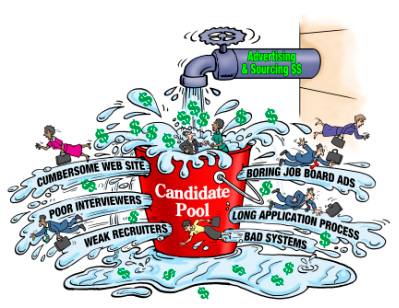
I ran across the graphic in this posting a few weeks ago and thought it did a great job of describing the reality of the job hunting experience for most people.  The posting was in a newsletter sent out by Electronic Recruiting Exchange (ERE).  Here is a link to that newsletter if you care to read it.

Ad-sourceThis image came to mind after receiving an email from a person in my professional network who is currently job hunting.  I had sent her a note earlier in the week asking her how things are progressing. 

“Still looking and sending out tons of resumes and applying to jobs. It is so hard.  I just don’t understand it. There are so many jobs posted, but they take forever to get back to me.  I received a call yesterday from [a major insurance company you’d recognize] that I applied for 2 months ago!”

If you’re one of the 13 million people looking for work right now, you probably have experienced similar frustrations.  As the graphic suggests, you’re not imagining things.  

Most companies are pathetic at hiring.  It is bad enough that there is a huge amount of inefficiencies (the wasted money could be used to pay the wages of more people), but it is even more disappointing to realize that the candidates are the ones who suffer the most. 

Unfortunately, this is reality, and it is not going to change in the near future.  Is there anything you can do to make the most of this reality?  I think so.  Here are a few ideas:

1.  Adjust your expectations.  If you’re responding to job openings posted by companies, expect delays, poor communication, mishandled paperwork, and other problems.  It doesn’t matter who you are or how qualified you are for a position; companies will still botch the hiring process.  People experience disappointment, discouragement, and even a sense of despair when expectations do not match reality.  Lower your expectations.

2.  Remember, it’s a numbers game.  If your hope is to see one perfect job posting, send the prospective employer a resume, and then get hired; what happens when thing don’t work out?  You’re devastated.  What if you’re working on 20 different opportunities and one doesn’t work out?  You still have 19 more opportunities.  Concentrate most of your efforts on keeping the opportunity bucket full.  Something will eventually work out.

3.  Sidestep the hiring system.  If companies are going to screw up the hiring process, maybe you should sidestep the process all together.  There are career gurus who espouse the benefits of looking for a job outside traditional techniques.  The most notable is Richard Bolles, but there are many others, as well.  Some of these techniques are worth investigating because they acknowledge that the system is broken and provide solutions from this premise.

Tomorrow, I’ll cover one of these techniques in detail.