
Basic Rules For Managing People


I like rules that make sense… Rules that have a purpose… Rules that are intended to make us more productive people.  Although I’ve touched on it previously, I’d like to revisit the topic of rules that govern human behavior.  Just yesterday I referenced the below material in responding to a client’s question.  Clearly, it continues to provide relevant insight for all of us.


Recruiting, coaching and work performance are governed by the rules of human behavior.  The rules Credibility aren’t always as ironclad as the rules of the physical universe, but they are fairly predictable.  While it may seem complicated, our job is to boil these principles down to rules that you can remember and practice on a daily basis.


Over the next few weeks, I will list and describe some of the rules regarding human behavior, and then dive into each of these rules in more detail in the months ahead.  I hope you follow along for the ride.


Rule #1:  The Rule of Relationship Credibility


Whether you’re recruiting new talent, coaching a team of high performers, or teaching others to recruit clients, you must understand the concept of relationship credibility.  Ask yourself this question:

“Can I generally figure out when someone is exploiting me for their own purposes?”

I think most of us have a good barometer for detecting when this is the case.  Likewise, those with whom you’re attempting to build a relationship can likely figure this out too.


If you want to draw in the very best talent, and draw out the most from them, then you need to understand what these individuals require from you.  Talented people want to have relationships, be understood, and be associated with people who are credible.


How is credibility built?  It is partially built through “process” and partially built through “substance.”


The definition of “process” is “a series of actions directed toward a specific aim.”  Consistent and thoughtful follow-up on your part, shows that you are dependable.  A well-conceived plan demonstrates integrity in your thoughts.  If those around you perceive that you only make contact when you want something, you will not be perceived as credible.  Executing and clearly communicating a process will prevent this from happening.


While process is important, substance is even more important.  “Substance” is defined as “real or practical value or importance.”  The substance in any relationship is most easily developed by learning about the other person’s story.  This is vital for managers because it gives both you and your (prospective) employee the opportunity to assess whether you are a good fit for each other, and whether joining your team fits into his/her life story.  Genuine interest in the lives of your employees fosters the development of substance in your work relationship with them, thus fostering your credibility.


Here’s what you need to know:  What drives this person?  What are their ultimate goals?  How does doing what they’re doing now fit into this goal?  How does it fit into their financial, family and retirement objectives?  How does it fit into their charitable affiliations?  How does it fit into their personal development?  The answers to these questions will illuminate the foundation of their life story.


If a person feels that you are genuinely interested in them, he/she wants to be asked these questions.  Having this exchange will give you the most valuable tool known to managers: relationship credibility.


With relationship credibility, you can begin to integrate every conversation regarding business plans, sales objectives, and talent development into a person’s big picture.  This will be experienced as authentic, natural, and mutually beneficial.

Defining Happiness – Part 3: Coaching for Happiness and Confidence


The most popular WorkPuzzle blog to date is titled “Coaching for Confidence.”  In order to achieve a state of true confidence, you need to have worked hard at developing a talent or set of skills.  This development never comes easily and is always built with consistent and copious amounts of time and effort.


If you’ve read WorkPuzzle the last couple days (Part 1, Part 2), you know that science says the same thing about happiness.  Happiness, or a life with abiding and deep satisfaction, takes work.


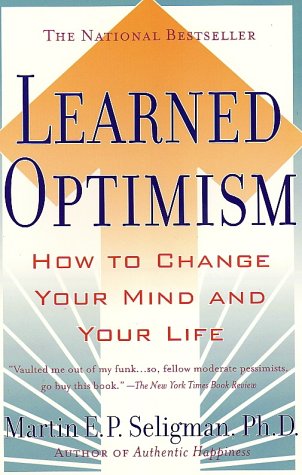
Martin Seligman's book "Learned Optimism" For coaches, parents, and managers, this is invaluable information.  Only with this information firmly planted into your frontal lobe, can you know how to begin answering questions and fielding complaints regarding frustration, failure, roadblocks, and anxiety.


Let me give you some examples of what science says about happiness and confidence, and then tell you how to apply it:


1. Success and happiness never come solely from “the pleasant life.”  The pleasant life is defined as:  A life dedicated to maximizing the amount of pleasurable experiences in both frequency and duration.  People who value this goal above all others, exhibit more depression and anxiety, and are more likely to report feelings of “emptiness.”  (Martin Seligman, “Learned Optimism”)


2. People report much greater well-being when working.  They feel stronger, more creative, satisfied, and good about themselves when they are at work.  Studies show that while at leisure, people fall into the range known as “apathy.”  They feel passive, weak, dull, and dissatisfied.


There is one more surprising finding here:  The above respondents, despite their “greater well-being”, ironically reported that they’d rather be somewhere else than at work.  The reason for this is that our culture has gradually created some very strong stereotypes about work, such as:  Work is an imposition, a constraint, an infringement of their freedom, and therefore something to be avoided.  (Mihaly Csikszentmihalyi “Flow:  Psychology of Optimal Experience”)


So, as a coach, when someone complains to you about how difficult it is to achieve what they want to achieve, and they insist that it should be easier – Remind them that everyone would be happy, confident, and successful if fulfillment was easily achieved.  Assign them the task of asking the happiest, most confident, successful people they know, how they got there.


I guarantee that the answer would be a long list of trials, failures, starts and stops, and difficulty.  Welcome to the life of a happy person!


Ralph Marston said it this way:

“If it were quick and easy you would have already done it.  The fact that it is difficult and time-consuming means you’re doing something truly worthwhile.  The value of any achievement is built with the time and effort you put into it.  Keep going, keep building, keep at it and you’ll truly have something of great value.  It is often difficult to stay positively focused.  And it is always worth the trouble.  Sure, it would be much easier to do nothing.  Yet by doing nothing, you create nothing.  Instead, step forward and do the difficult work that must be done.  With each effort, you are adding more value and substance to the achievement.  Feel the satisfaction as you continue the difficult and rewarding work of building that achievement.  Know that the value has already started coming to life.”

Defining Happiness – Part 2: Coaching


Ben’s article opens the door to possibly an entire series of articles.  You see, if we don’t understand both the causes and the impact of happiness, we really can’t have any influence over anyone.  We must appeal to what really makes people happy to engage them on any meaningful level.


All science around human flourishing can be summed up in one sentence: “It turns out that we are very poor predictors of what makes us happy.”  (Seligman, Csikszentmihalyi, and Diener all say in separate writings)


Why are we such poor predictors of what makes us happy?  Basically, it’s because we get sidetracked by the ever increasing availability and temptation of short-cuts and instant gratification.  Additionally, volumes of evidence suggests that for the last 60 years we have been told (from teachers, parents, media, friends, and public policy) that happiness is attained by those who increase their pleasurable experiences in both frequency and duration. 


Science, however, tells a different story…  Research shows that this mentality (the belief that we need to do more fun things in life to be happy) leads to an increase in societal and personal depression and anxiety.


Science has found that…ouch, here comes the bad news.. happiness takes work!  It takes character development, delayed gratification, engagement in ones work, strong marriage (this has the highest correlation to happiness), playing an active role in developing ones children, and having goals that are built upon deep beliefs and purpose.


Increasing happiness in ourselves and in others undoubtedly takes work.  But, if your responsibilities include coaching others, the knowledge is invaluable.  You can begin to ask:


1. Are you happy?
2. Let’s figure out why or why not? (If I can’t help your overall happiness quotient, what’s keeping you from moving to another office?
3. What do you believe will make you happy here?
4. How are your goals in this job related to your overall goals in life? 


Side Note:  If the person only focuses on the financial picture, ask them:  How does this fit into your goals for your family, community, or faith?  If your approach strikes them as new and different, let them know that you are dedicated to helping them see the whole picture.  You want them to work hard, but it has to be toward something with more meaning than money (…although this is certainly part of the picture and not at all bad in itself!).


Here is an example of a work-related goal you may elicit:  “I want to be good at what I do, and service my clients better than they have ever been serviced…”  Now that’s a goal!  But, again, it takes hard work.  When they succeed, they’ll feel deeply satisfied and very grateful to you. 


It will take time, planning, execution, and effort, because remember…there are no shortcuts to happiness!

Defining Happiness


One of the purposes of WorkPuzzle is to facilitate a dialog concerning what makes people flourish in their work.  Typically, we address this topic from a scientific perspective.


Charles-murphay Last week, I ran across the transcript of a speech given by Dr. Charles Murray at the 2009 Irving Kristol Lecture in Washington DC.  Dr. Murray is a social scientist and author who is most famously known for his controversial book, The Bell Curve (1994),that discusses the role of intelligence (IQ) in American Culture.


Recently, Dr. Murray has been studying happiness.  He approaches the topic from a government/public policy perspective, and much of what he says is probably beyond the interest of the general public.  You’re welcome to read the whole speech, but I thought it would be helpful to highlight a couple of passages that would liven our WorkPuzzle discussion.


1.  Dr. Murray does a great job of defining happiness:


“I start from this premise:  A human life can have transcendent meaning, with transcendence defined either by one of the world’s great religions or one of the world’s great secular philosophies.  If transcendence is too big a word, let me put it another way:  I suspect that almost all of you agree that the phrase “a life well-lived” has meaning.  That’s the phrase I’ll use from now on.

And since happiness is a word that gets thrown around too casually, the phrase I’ll use from now on is “deep satisfactions.”  I’m talking about the kinds of things that we look back upon when we reach old age and let us decide that we can be proud of who we have been and what we have done.  Or not.

To become a source of deep satisfaction, a human activity has to meet some stringent requirements.  It has to have been important (we don’t get deep satisfaction from trivial things).  You have to have put a lot of effort into it (hence the cliché “nothing worth having comes easily”).  And you have to have been responsible for the consequences.”


2.  Dr. Murray identifies the arenas in life where happiness are derived:


“There aren’t many activities in life that can satisfy those three requirements.  Having been a good parent.  That qualifies.  A good marriage.  That qualifies.  Having been a good neighbor and good friend to those whose lives intersected with yours.  That qualifies.  And having been really good at something–good at something that drew the most from your abilities.  That qualifies.

Let me put it formally:  If we ask what are the institutions through which human beings achieve deep satisfactions in life, the answer is that there are just four:  family, community, vocation, and faith.  Two clarifications:  “Community” can embrace people who are scattered geographically.  “Vocation” can include avocations or causes.

It is not necessary for any individual to make use of all four institutions, nor do I array them in a hierarchy.  I merely assert that these four are all there are.  The stuff of life–the elemental events surrounding birth, death, raising children, fulfilling one’s personal potential, dealing with adversity, intimate relationships–coping with life as it exists around us in all its richness–occurs within those four institutions.”


If you have the responsibility of coaching someone, these definitions can be very helpful in coming to a common understanding concerning the nature of happiness in a person’s life.  It is also useful  to have a framework for positioning work (vocation) among the other significant areas from which happiness can be derived.

Navy SEALs Have a “Growth Mindset”


My 14-year old son has a strong interest in the Navy SEALs.  He has read several books about this elite group of warriors and recently wrote a school paper describing their training methodologies.


Navy SEAL Hitting the Beach I read last Friday’s WorkPuzzle article on the “growth mindset” to our family at the breakfast table.  It was an appropriate topic since we often discuss the importance of working hard and improving our abilities.


Upon hearing about the “growth mindset,” my son immediately piped up and said:


“Dad, this is a core principle of Navy SEAL training!  In order to acquire the abilities necessary to be a SEAL, a person must consistently be taken to the edge of their abilities – This makes a person feel like they are going to die.  At this point, those who believe that they can improve, push forward in the training.  Those who don’t have this belief, will voluntarily quit or Drop on Request (DOR).”


This is consistent with what the statistics show:


“SEAL training and duty is voluntary….  Classes typically lose around 70-80% of their trainees – either due to DORs or injuries sustained during training.  The Navy will not release exact numbers, either percentages or raw figures, of the attrition rate for BUD/S…

There is no way to predict what percentage of trainees will DOR during BUD/S.  SEAL instructors say that in every class, approximately 10 percent of the students do not have the physical ability to complete the training, and another 10-15 percent will make it through unless they sustain a serious physical injury.  The other 75-80 percent is “up for grabs.”  During one BUD/S class, no one completed the six-month program!”


To make the numbers easy, let’s suppose a class consisted of ten people.  About three of the ten will be disqualified due to physical limitations (injury or lack of ability), and another three will make it through the training and become SEALS.


Why don’t the other four trainees make it?   Because of what is going on inside their mind.  It is not a direct physical limitation, but a mental limitation.  It is a belief that their abilities have reached an upper limit and they can no longer grow to meet the next challenge.  The “growth mindset” is part of what equips a person to see beyond the pain and persevere.


If you have the responsibility of coaching and managing those on your team, then it is likely that many of them are stuck in the belief that they have reached the limits of their abilities.  Help them see that their abilities can grow as their challenges grow.  Like the SEALs, some of them may grow into doing things they never thought possible.

The #1 Essential Belief for Coaches and Managers


I’ve been following the work of Stanford Professor Carol Dweck over the past few years concerning the research topic she calls “growth mindset.”   Her research on this subject is about as compelling for a coach or manager as anything that I have ever seen.


Simply stated, she has shown that people who have a growth mindset believe that they can increase their level of ability and intelligence through hard work.  This is especially true if a person believes they are at an initial disadvantage compared to others.


Dr. Dweck has consistently demonstrated that people who believe their intelligence and abilities are fixed respond dismally to failure. They often feel hopeless and depressed because they believe there is little they can do to change the outcome of their futures.


In the realm of education, she has even discovered that students who are taught about the growth mindset do remarkably better than those who receive traditional skills training (ex. study skills, time management skills, etc.)


It is not difficult to make the connection to the business world.  As a manager, you’ll have a much greater return on the time you spend with your direct reports if you apply these principles.  This may seem counterintuitive, but it is better to assess and build the growth mindset in those you coach than spend time teaching them the skill-based steps to success.


Check out this interview with Dr. Dweck for some interesting perspectives:


Note:  If you’re an email subscriber, see the Dr. Dweck video by visiting WorkPuzzle


Like anything, you’ll need to internalize these ideas to effectively teach them to those you coach.  Here are some questions you can ask yourself on this topic: 
Do I have the growth mindset or a fixed mindset?


Do I feel anxious and depressed after failing?


Do I avoid tasks because of the fear of failure?


Do I put less effort into tasks because I feel hopeless about making progress?


Do I find that when I’m carrying out a task, I am worried about how good I look at it, rather than what I am learning from it?


Do I miss learning opportunities because of fear of failure?