
Predicting Who Will Make a Job Change


Recruiting is a time consuming process.  Nothing is more frustrating than spending time and effort pursuing a candidate who is not willing to make a change.  You not only lose the time you spent trying to dislodge someone who is stuck, but you also forfeit the opportunity of engaging someone else who might have a higher propensity to change jobs.


With the susceptibility for such waste, it makes sense to put some thought into the inclination a person has for change at an early stage in the recruiting process.


Miller-Heiman Many years ago, Steve Hieman, the co-founder of the sales training company Miller-Heiman, developed a model for thinking about change.  The model was built to help salespeople understand how decision-makers would potentially react to sales proposals.


Heiman observed that people generally fall into one of four modes depending upon their perception of reality:


1.  Growth Mode:  The perception that there is a hopeful difference between today’s reality and the potential for short-term gains.  Something needs to be done to reach the potential.


2.  Trouble Mode:  The perception that today’s reality will soon deteriate.  A person in this mode has anxiety about the difficulty looming on the horizon.  Something needs to be done to avoid the trouble ahead.


3.  Even Keel Mode:  The perception that that there is no difference between today’s reality and what will actually be accomplished in the months ahead.  “Rocking the boat” is risky and unnecessary.


4.  Overconfident Mode:  The perception that growth and prosperity are inevitable.


If you think about these concepts from a recruiting perspective, the definitions apply.  Each candidate tends to have a perception of reality that matches one of these modes. 


It’s not hard to figure out a candidate’s mode during a conversation.  The questions that get a candidate to reveal his/her perception of reality are natural and easy to ask.  Once you’ve made this assessment, you have some insight into the candidate’s propensity to change.


Candidates who are in a Growth Mode or Trouble Mode have a high likelihood of making changes.   Candidates who are in an Even Keel Mode have a much lower chance of making a change.  And candidates who are Overconfident have very little chance of making a change.


In working with a candidate in your talent pipeline, those in the Growth or Trouble Mode are going to be much more open to direct conversations about making a job change.


Those who are in an Even Keel Mode will most likely need to percolate over time.  As a recruiter, staying in touch and being seen as an indirect resource is the best way to spend your time while you wait for an external event to dislodge them from the Even Keel mode.


Those who are Overconfident will not be responsive until they “crash and burn.”   It’s a waste of time to try to engage them until their arrogance causes them to enter the Trouble Mode themselves.


Try making these assessments with the people you work with this week — See how quickly you can become adept at assessing their modes.  With this knowledge, you’ll be more focused on the activities that produce results.

5 Reasons to Keep Building Your Talent Pipeline During a Recession


Last week, I ran across an article that answers a question that we get frequently:

“Should we continue to invest in recruiting while the economy is in such bad shape?  Or, would it make more sense to pull back our efforts and concentrate on other things?”

Pipeline The article was written by Pedro Silva.  Silva is a Candidate Relationship Manager with JCSI, a staffing company in Boston, Massachusetts. 


Silva makes the point that the recession is being blamed for a lot of things that really have nothing to do with the economy.  It becomes justification for some people, to do nothing.


If you’re a recruiter or hiring manager, inaction now means poor results later.  Silva goes on to encourage us to continue the process of building our candidate pipelines even though times are tough: 

“Below are five powerful reasons why companies that want to come out on top will continue to develop their candidate pipeline.


1. Pipeline development is part of their growth strategy. You don’t wait until it snows to gather firewood, and these companies don’t wait until they need a hire to start identifying candidates who are equipped to be a part of their company’s success.


2. They know that long-term hiring success requires a process. It is a lot easier to keep a fire going than it is to start one, so these companies will start an ongoing dialogue with candidates with the intention of making an offer when the time is right.


3. A developed candidate pipeline removes major competition from the equation. When the time to hire arrives, these companies either have their offer prepared or they are at the top of the candidate’s mind. This reduces the chances of a salary war.


4. Having qualified candidates on hand minimizes delays in production.  A developed and managed candidate pipeline allows these companies to rebound quickly and efficiently.


5. A company that is actively recruiting is considered a strong company.  By continuing to engage prospective candidates, these companies strengthen their own company brand among others in their industry and remain aware of other trends within their market segment.”

My favorite on the list is #2.  Several of our clients have cut back spending due to financial difficulties, but they’ve had the wisdom to keep their hiring systems active at a reduced level, rather than stopping altogether.  Restarting the fire is difficult.


The last reason, #5 on the list, also resonates with me.  Many of our clients strive to be perceived as strong and healthy by consumers.  This perception is critical to mounting their own recovery.  Recruitment advertising is a great way to help build the perception of health.  With 30% of the workforce in some mode of job search at any given time, your recruiting ads are in front of many job seekers and potential customers. 


Visibility and proactivity is key in separating yourself from your competitors.  Don’t wait for the recovery to begin…if you do, you’ll be lagging behind those who are working now.

Coaching for Focus, Attention, and Success


On Friday, I described the neuroscience regarding the importance of maintaining focus.  Brain research confirms that we can shape how our brains operate and perform by training them to focus intently on the desired end-result.  To do this with the most positive results, we must help the brain stop doing what its oldest parts are trying to do– keep us alive!


Mountain biker You see, above all else, the brain’s primary purpose is to keep us from dying.  How?  The brain does this by focusing on what can go wrong; by focusing on the dangers; by focusing on the obstacles; by focusing on the negative.  This is the brain’s default position.


But, unlike other animals, we have this enormous cerebral cortex that surrounds the oldest part of the brain (the lymbic system).  If we always give in to the danger signals that the lymbic system is sending out, we’d rarely take chances, innovate, face rejection, or progress in our development.


Here’s an example of how performance can be enhanced by training the brain to filter out obstacles and focus on the goal at hand:


I’ve been mountain biking for the past 14 years.  I’m by no means an expert, but I get by.  The first thing anyone learns in mountain biking technique 101, is that your bike will go where your eyes are looking.  If your eyes are looking at a tree, you’ll hit the tree.  If you’re looking at a rock, you’ll hit the rock.


Now, your brain actually wants to look at the rock… it’s literally screaming at you… “There’s a rock you idiot!  You’d better look at it…and while you’re at it, slow down for crying out loud!” 


There are some people who will never progress in single track mountain biking, because they can’t train their minds to not look at the rock.  The people who become proficient bikers, are able to train their brain, over time, to focus ahead, around the upcoming curve, toward the open trail…to where they really want to go. 


This task takes discipline and repetition.  Soon your brain has realized, “I am not only staying alive by looking beyond the trees and rocks, I’m having pleasure and success by doing it this way!”


I’ve heard this same principle applies to race car driving.  At those speeds, you can’t look at the wall.  If you do, you’re dead!


Success for you and those you manage is no different.  If your team is constantly looking at the obstacles, you’ll inevitably hit them, head-on.  Likewise, if you’re constantly looking at the “bad market,” you’ll be dragged down by it. 


Success comes to those who can train their team (self included) to look toward the vision, the goals, and the opportunities.  A culture built on this mind-set, is one that will survive and thrive, while the “others” out there will continue to hit trees…  

The Neuroscience of Change


One of our readers recently sent me a very good article titled, “The Neuroscience of Leadership,” by David Rock and Jeffrey Schwartz.


Although it certainly pertains to leadership on some level, it is really more about change.  The authors Neuroscience of Change did an excellent job synthesizing a good deal of brain research into understandable applications around some of the challenges of producing change in organizations.


Here are some tidbits:

  1. Change is pain.  Organizational change is unexpectedly difficult because it provokes sensations of physiological discomfort.

  2. Behaviorism doesn’t work.  Change efforts based on incentive and threat (the carrot and the stick) rarely succeed in the long run.

  3. Humanism is overrated.  In practice, the conventional empathic approach of connection and persuasion doesn’t sufficiently engage people.

  4. Focus is power.  The act of paying attention creates chemical and physical changes in the brain.

  5. Expectation shapes reality.  People’s preconceptions have a significant impact on what they perceive.

  6. Attention density shapes identity.  Repeated, purposeful, and focused attention can lead to long-lasting personal evolution.

Points four and six are most interesting to me – Focus is power and Attention density shapes identity:

“Concentrating attention on your mental experience, whether a thought, an insight, a picture in your mind’s eye, or a fear, maintains the brain state arising in association with that experience.  Over time, paying enough attention to any specific brain connection keeps the relevant circuitry open and dynamically alive.  These circuits can then eventually become not just chemical links but stable, physical changes in the brain’s structure.

Cognitive scientists have known for 20 years that the brain is capable of significant internal change in response to environmental changes, a dramatic finding when it was first made.  We now also know that the brain changes as a function of where an individual puts his or her attention.  The power is in the focus.  Attention continually reshapes the patterns of the brain.


The greater the concentration on a specific idea or mental experience, the higher the attention density.  With enough attention density, individual thoughts and acts of the mind can become an intrinsic part of an individual’s identity:  Who one is, how one perceives the world, and how one’s brain works.  The neuroscientist’s term for this is self-directed neuroplasticity.”

This is exciting information to me.  I have seen this research in various forms, coming out of all avenues of science.  Additionally, I have seen first hand the impact of people falling into old (safe) patterns of thinking based on old experiences, simply because it’s what they’ve known and focused on previously.


I have also seen the subsequent life change that occurs when attention shifts to a new way of thinking or feeling.  Ask yourself… “Where am I stuck?”… “What am I focused on that is keeping me there?”… and “What should I focus on to get where I’d like to be?”

GIT-R-DONE Discipline


Yesterday, my favorite morning radio program featured “Larry the Cable Guy.”  He was live on the air for about ten of the funniest minutes I’ve ever experienced.  I’ve never really given the guy a chance, quickly changing the channel whenever coming across him on T.V.  I have to admit, however, he had me in stitches during the entire show.


Larry the Cable Guy In listening to the interview, it became apparent that  he’d been on this radio program before, typically to promote an upcoming performance in the Seattle area. 


Near the end of the interview, the host mentioned that every time Larry is a guest on the show, he seems to have brand new material.  The host was curious about how he managed to keep his act so fresh and not repeat any old material.


For the first time in the interview, Larry became very serious and replied:

“For the past several years, I have disciplined myself to write comedy bits for two hours every day.”

He went on to describe how he frequently has to force himself to find time to write.  Even on those days when there seems to be no time… he “forces” himself just the same.  He credits his great success to holding steadfast to this discipline, and believes that he wouldn’t have lasted in the competitive world of comedy without it.


The lessons here are so clear:


1. What appears effortless, usually takes an incredible amount of diligence and hard work behind the scenes.
2. Any success that lasts, is built on hard work and consistent discipline.
3. There are no short-cuts to success.
4. Your success is up to you.  No pointing fingers.
5. You’ve got to have a system!


No matter what you do, without a system and accountability to that system, you probably won’t accomplish what you intend to.  For example, if recruiting is part of your job, you can’t be flying by the seat of your pants.  You must set aside a certain period of time every day to recruit within the parameters of a system.  Only by doing this day-in and day-out, without fail, will you succeed.

“I find the great thing in this world is not so much where we stand, as in what direction we are moving:  To reach the port of heaven, we must sail sometimes with the wind and sometimes against it, but we must sail, and not drift, nor lie at anchor.” (Oliver Wendell Holmes)

Coaching From the Back of a Bass Boat


Over the weekend, I had the pleasure of flying to Nashville with one of my sons for a fishing trip.  My brother lives about an hour’s drive north of Nashville and invited us to camp and fish with him and a friend in the Peabody Wildlife Management Area (PWMA).  The PWMA is a 60,000 acre preserve that was reclaimed after this area was strip-mined for coal in the ’50s and ’60s.


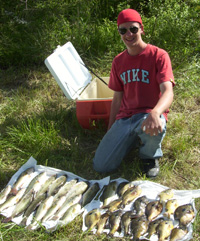
50+ bass and large bluegills This trip signifies a change in the role that I have in my son’s life.  In our family, we believe that childhood can be broken into three phases:  The focus of the first phase (0-6) is keeping the child alive (two-year olds have a propensity for doing things that could result in death) and teaching them to respect authority.  The second phase (7-14) is focused on character development.  And in the third phase (15-21) the focus is on coaching the child as they “practice” real life.


For each of my kids, I plan a fun trip as they enter the third phase of their childhood.  During the trip, I talk with them about how my role is going to change to that of a coach.  It’s their job to step-up and start to use the things that they’ve been given and conceptualize a life of their own.  These have been some of the best experiences in my life.  Work is important, but to see the same principles and concepts apply to life as a whole brings a deep level of satisfaction.
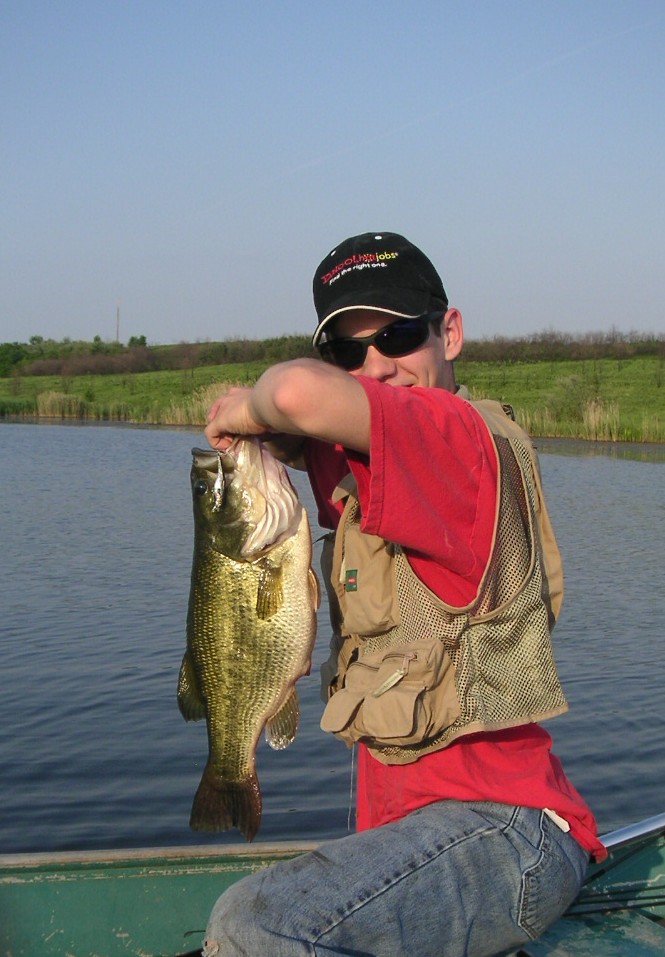
  11-pound bass
For those of you who love fishing, I’ll throw in a few details about the trip itself.  The PMWA lakes (there are hundreds of them) contain largemouth bass, bluegill, catfish, and other warm water species.  During the two days of fishing, we caught more than 50 bass and large bluegills (1st picure).
 
In timing the trip, we attempt to fish right after the female bass finish spawning.  The female bass are larger than the males, and they don’t eat while they are spawning.  So, right after they finish spawning, they’re particularly hungry which makes the chances of catching a big fish much better.  Because it was a cool spring in this part of Kentucky, we missed this ideal timing by a week or so.


I did this same trip two years ago with my oldest son and we hit the spawning window perfectly.  During that trip, he caught an 11-pound bass from one of the PMWA lakes (2nd picture).  If you click on his picture, you’ll get an enlarged version.  Don’t you think HotJobs should have paid us a royality for wearing that hat?