Managing Your Talent Pipeline


Here is a question we often receive from hiring managers:

“I’ve identified someone who I think would be a great addition to my team, made initial contact with that person, but realize that the timing is not quite right for them to leave their current job.  Now what?  How do I stay in contact with this person over time in a way that will eventually result in a hire?”

This is where a lot of people get stuck.  They make the initial contact with enthusiasm, but there is not enough substance in the relationship to initiate further contact without feeling awkward.


Over the next couple of days, I’m going to share some things that we’ve learned on this topic from some of the best recruiting companies in the country.  Hopefully, you’ll be able to take some of these ideas and apply them to your talent pipeline.


There are two basic rules that I recommend you follow when working with your candidates:


1.  Ask for permission.  Seth Godin made his debut into the consulting/marketing world by figuring  out that people like to be respected in the marketing process.  In Seth-godinfact, they respond much better when they are treated with respect.  In his bestselling book Permission Marketing, Godin makes the point that respect is shown by asking a person if it is OK if you market to them.  By the way, this is where the concept of the “opt-in” email originated.


Recruiting is marketing.  When you make initial contact with a candidate and you believe there is some potential for the future, ask a simple question:  “Would it be OK if I followed-up with you occasionally?”  It is a natural question to ask, and most people will say yes.  By dong this, you show respect and you set an expectation for future contact.


2.  Add value with each subsequent conversation.  John Sumser, a recruiting expert and author, often makes the point that any communication with a candidate must provide the candidate with something of value.  More specifically, the value of what you provide in the conversation must exceed the value of the candidate’s time and attention to take the call or answer an email.  If this does not happen during each conversation, the candidate will no longer want to talk with you.


Think of it like a scale that rests on a center fulcrum – If you’re extracting value from the candidate (you want their time and attention), the scale tips towards you.  You’re getting something, but not giving something in return.  Only dysfunctional people put up with this type of imbalance.  Good hiring managers make sure the scale is always tipped toward the candidate, and not just a little bit–a lot.


In the upcoming articles, we’ll offer some ideas to help you get the scale to tip in your candidates’ favor…

The Benefits of Success


Over the past several days, Dave has been teaching about the benefits of failure.  This is an important topic because it is so counter-intuitive to how we naturally think.  I hope you had the opportunity to read and digest this important information.


Dave’s last point in Friday’s article struck a chord with me due to some personal events in my life over the weekend.  My family and I attended the memorial service of a dear friend, Roger Shaeffer.  Roger passed way at the age of 88, after a short bout with cancer.


What struck me about Roger’s life was not his failures, rather his successes.  He was one of the most successful people I’ve ever known—not in the terms that we normally ascribe to success, such as personal finances, assets, etc. (although he was successful in these areas as well), but in terms of the positive impact he had on other people.


There is no way I could possibly capture the significance of Roger’s life in a short article – one of his sons wrote a letter that took 15 minutes to read during the memorial service, and he admittedly just scratched the service!  But, I can share a few things that I learned about success from Roger.


1.  Success means making those around you better individuals.  During a time of sharing memories, about 25 people recalled a happy memory of Roger.  Most of these people started the story with, “Roger made me a better person by….” 


2.  Success means encouraging those around you.  Roger loved to sing.  I knew this from being around him, but I was surprised how many others also had this memory of Roger.  He would burst into song on almost any occasion.  How can you not be happy when someone around you is singing?  What I learned last night was that he did that more for the benefit of those around him, than for himself.


3.  Success means being generous and thankful.  I don’t believe there was a person at the memorial service (and there were hundreds there) who had not received something from Roger.  For my two-year-old daughter, it was a pinch on the cheek and a bright smile.  For my sons, it was the Seattle Mariners tickets every year.  For me, it was the World War II combat stories and the encouragement to be a faithful Dad.  Everyone else had their memories as well, but the common thread was that he always gave with a belief that he had been blessed with so much.


The lesson here is that we’re all going to face failures and setbacks—especially when it comes to careers, jobs, finances, personal goals, and maybe even relationships….it’s part of life.  However, Roger has reminded me (and I’m reminding you) to take the time to invest in the people/relationships that ultimately result in a truly successful life—even when you are going through difficult times.  This type of investment doesn’t take a lot of money–it’s more about having a warm heart and a willing spirit. 

The Benefits of Failure – Part 3


The last two days, and particularly Friday, I discussed failure as an integral part of learning.  You now understand that the brain grows best by experiencing multiple failures.


Today, I’ll focus specifically on the big failures in life… You know, the ones where you feel like the sky is falling, you’re an idiot for making that decision, how could you let this happen, life will never be the same….those kind of failures.


In a recent Psychology Today article, I found a helpful list to consider in those darkest days of (what seems like horrible) failure.  Here are nine ways to fail better:

“1.  Lighten up – Most people who bounce back from setbacks have a sense of humor.  They know when they’re taking things—and themselves—too seriously… It’s hard to find the funny in the fine grain.  Humor is about stepping back for fresh perspective.  We assume that’s something we’re born with, but we can become better at seeing the lighter side by sheer exposure to that way of thinking.  And it does take the edge off of failure.  After all, an embarrassment today makes for an entertaining story tomorrow.


2.  Join the club – Misery loves company.  Just look at the growth of Web-based support groups like ‘15,000,000 Recession-Touched People’ (on Facebook) and Global Depression Support Group (on meetup.com).


There’s real value in commiseration.  When Montrealer Sylvain Henry started a Facebook support group called ‘Recession Survivors’ after being laid off from a software company, the group became a lightning rod for pain and blame.  ‘You’ve gotta blame someone, right?’  Henry says.  ‘Whose fault is this?’  People vented about the lost house, the failed marriage.  It was cathartic.


Then something happened.  ‘People vented themselves out,’ Henry says.  ‘After that came another impulse:  Let’s do something about this.’  The members began posting productive hints, little money-saving tips about budget-friendly cookie recipes or how to throw a good garage sale.  The site transformed into a clearinghouse of resourceful coping strategies for hard times.  Call it Failing Better:  the Open-Source Edition.


3.  Feel guilt, not shame – The difference between guilt and shame is the reason we assign as to why failure occurs, notes Richard Robins, a psychologist at the University of California at Davis.  Guilt says it’s ‘something I did.’  But shame means feeling failure occurred because of ‘something I am’—in which case, you expect failure and don’t act to avoid it.


But the cycle of learned helplessness can be broken.  Instead of thinking ‘I’m a failure,’ think ‘I’m a good person who made a mistake I can learn from.’  If your story about failure is, ‘It’s all my fault,’ you might need to practice looking outward and ask yourself, ‘What other things—things that aren’t about me—might have caused this negative event?’


On the other hand, if your story is, ‘It’s never about me,’ you may need to seek out some aspects of the problem you can do something about.  Because let’s face it, you do mess up—everyone does.  In which case you need to own the failure, see what you can learn from it, and move on.


4.  Cultivate optimism – Of the seven learnable skills of resilience—emotion awareness, impulse control, multiperspective thinking, empathy, the belief that you can solve your own problems, taking appropriate risks, and optimism—the most important is optimism, says Karen Reivich, a psychologist at the University of Pennsylvania.  ‘There is nothing either good or bad but thinking makes it so,’ said Hamlet, and indeed, paying attention to the positive infuses the world with hope—and creates a climate in which failure loses its sting.


The key to resilience is thinking more flexibly and learning to increase your array of options.  The psychologist Martin Seligman advocates disputation, in which you think of your mind as a courtroom where negative thoughts are instantly put on trial.


You can rebut these thoughts, and you should.  Now you’re acting as your own defense counsel, throwing at the court every bit of evidence you can think of to prove the belief is flawed.  The bad thought is no longer a lock, and it dies amid the doubt.


5.  Ask not what the world can do for you… – Getting fired and left without savings or health-care coverage is rough, but for some, it carries an unexpected message:  ‘Now you are free.’  Free to do something more meaningful with your life—like volunteering overseas.  If you don’t have to earn money right away, ask yourself:  How can you be of service to others?


6.  Scale down your expectations for yourself – When we succeed, we tend to just ratchet up our expectations for ourselves and not get a lot of pleasure out of it.  But when we fail, it’s much harder to ratchet down our expectations for ourselves.  ‘That might be what failing well is,’ says psychologist Jonathan Haidt.  ‘A willingness to lower our sights when that’s realistically required.’


7.  Harness the Bridget Jones Effect – Keeping a journal can help you cope with failure.  Jamie Pennebaker, a psychologist at the University of Texas, studied middle-aged engineers who’d lost their jobs.  Those who wrestled with their feelings about the trauma through journaling were far more likely to find reemployment.  It wasn’t simply the tension-relieving ‘catharsis’ of getting their feelings out.  Nor was it that they were more motivated to get out there and pound the pavement—they didn’t receive more phone calls, make more contacts, or send out more letters.


Rather, writing helps create meaning — finding coherence and building a personal story that lassos all the question marks hanging in the air and making sense of them.  Writing about their feelings forced them to come to terms with getting laid off.  It also boosted their social skills—making them more likeable, less vindictive, and better able to get on with things.  They were less wrapped up in their past.  They could listen better and were more optimistic and less hostile.


8.  Act! – Failure is an opportunity to change course.  Seize it.”

And I’m going to provide one of my own:


9.  Use major failures as a reminder to return to the things you value most in this world  These things are less transient: Your faith, your family, building community, etc…


Research has found quite clearly that the values listed above are associated with much higher levels of well-being than are the values of materialism, physical attractiveness, and financial success.  Know where you can bank on the deepest satisfaction… 

The Benefits of Failure – Part 2


In yesterday’s post I introduced some of the newer thinking around the concept of failure.  Specifically, I revealed that failure is a fairly important ingredient for future success.


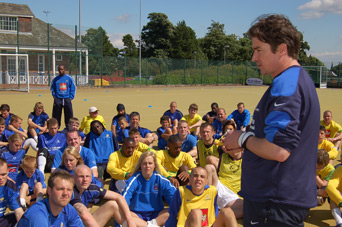
Simon Clifford coaching Brazilian Soccer As promised, today I am going to update you on what the brain does with failure.  It’s actually quite fascinating to learn that how you handle failure either gives, or takes away, your brain’s ability to grow and learn.


Your brain is made up of millions of neurons and synapses, all with the ability to build super highways of super speed.  All that is needed to build these connections is a substance called Myelin.  Myelin, it’s recently been found, has the ability to grease the skids between neurons so that large pathways are formed to create mega bandwidth learning and growth, if given the opportunity.  And guess what gives your brain the greatest opportunity for Myelin production?… Failure!  Not just failure, but lots of failure…the more the better!  And not just large doses of failure, but failure and correction, failure and correction, failure and correction


Here’s an example:


In 1997, Soccer Coach, Simon Clifford, was so curious about what caused Brazilian Soccer to be so successful, that he temporarily moved to Brazil and lived in a dimly lit dorm-like setting to find out first-hand.  What he found has changed the way many elite youth soccer teams practice, and has made Simon Clifford a very wealthy man, given that he has founded worldwide “Brazilian Soccer Schools” all over the globe.


What he found was that everyone, except the professionals, were playing a much smaller game of soccer on a small, hard court, with a heavier ball.  Given the small space, the game moved quickly and frantically, with split-seconds to decide where to pass, to whom, and how.  In other words, unlike American Soccer, Brazilian Soccer offers many more chances to fail and succeed in each minute of play, for each player – Every player touches the ball six times more per minute, to be exact.


When the brain experiences this incredible frequency of failure and correction, it grows Myelin like mad!  Super highways are formed that can ultimately lead to amazing talent.


So what does all of this have to do with us?


I’d love some comments about how you believe this can be applied…but here is one broad idea:


As you coach or mentor others, encourage them (and place them in positions) to fail.  Then have feedback sessions, then allow them to fail some more, then more feedback, etc, until they get it.  And when they do, more than likely, they will thank you for the growth you enabled them…


Reference:  The Talent Code, by Daniel Coyle

The Benefits of Failure


If you recruit, coach, mentor or parent others, you will benefit greatly from the next few blogs…  Ask yourself these questions:  How do you deal with failure as a coach?  As a recruiter?  How do you deal with your own failure?


No one likes the feeling of failing – It can be devastating to our egos.  Failure in one area of our life has a way of impacting every other domain.  So, many of us try to avoid failure at all costs.  J.K. Rowling Consequently, many of your employees and those you are attempting to recruit become frozen in a fear of failure.  So, what is an effective way to address this fear?


There is a rapidly growing body of evidence revealing that failure is not only essential to learning, but can also have a positive effect on our psyches.  The more rapidly you fail, pick yourself up, and then try again, the faster you perfect your skills.  Interestingly, the most successful people attribute their successes to countless failures.


The following is an excerpt from the June edition of Psychology Today:   

“Some psychologists, like the University of Virginia’s Jonathan Haidt, …argue that adversity, setbacks, and even trauma may actually be necessary for people to be happy, successful, and fulfilled.  ‘Post-traumatic growth,’ it’s sometimes called.  Its observers are building a solid foundation under the anecdotes about wildly successful people who credit their accomplishments to earlier failures that pushed them to the edge of the abyss.


Last fall, J.K. Rowling described to a Harvard grad class a perfect storm of failure—broken marriage, disapproval from her parents, poverty that bordered on homelessness—that sent her back to her first dream of writing because she had nothing left to lose.  ‘Failure stripped away everything inessential,’ she said.  ‘It taught me things about myself I could have learned no other way.’


Apple founder Steve Jobs describes three apparent setbacks—dropping out of college, being fired from the company he founded, and being diagnosed with cancer—that ultimately proved portals to a better life.  Each forced him to step back and gain perspective, to see the long view of his life.  ‘I have failed over and over and over again, and that is why I succeed,’ said Michael Jordan—as did Oprah, Walt Disney, Henry Ford, Winston Churchill, and Thomas Edison, in slightly different words.  Indeed, so oft-repeated is the trope that we lose sight of how strange it is.’
 
…’Failing better’ boils down to three things.  It’s a matter of controlling our emotions, adjusting our thinking, and recalibrating our beliefs about ourselves and what we can do in the world.


‘Chess is a game of failure,’ says Bruce Pandolfini, an American chess master known for his work teaching young chess players.  (Sir Ben Kingsley played him in Searching for Bobby Fischer.)  ‘At the beginning, you lose—a lot.  The kids who are going to succeed are the ones who learn to stand it.  A lot of young players find losing so devastating they never adapt, never learn to metabolize that failure and to not take it personally.  But good players lose and then put the game behind them emotionally.’


Pandolfini teaches his students this calming sense of perspective.  The present moment is laid out against the past.  What you see is compared to your memories of what you’ve seen—and mastered—before.  What you have in the end is a kind of coherent story.  He calls it chess instruction, but really, it works with anything.  In fact, it’s not so different from the way writing down your feelings in a journal helps you process failure and move on, a phenomenon demonstrated by James Pennebaker, a psychologist at the University of Texas.


Teachers, studies reveal, can foster resiliency among students, creating students who don’t flinch from failure but actually welcome it as a learning opportunity.”

As a manager, how can you adopt this way of teaching, coaching and encouraging your employees/agents?  How can you begin to teach “chess instruction?”


Tomorrow, I’ll discuss the neuroscience of failure and success… It will have you yearning to fail more! 

“Me…Me…Me… I Think I’m Really Close On This One!”


As we discuss some of the best practices of working a talent pipeline, I’d like to address one major pitfall that many recruiters fall into….the oh-so-tempting art of manipulation.


When you’re working with a candidate in your talent pipeline, there is a temptation to manipulate events and circumstances in an attempt to create a short-cut to the end result of the recruiting process.  Remember, in the recruiting process, timing is everything, and it is controlled by the candidate, not you!  If the process is forced, talented candidates will quickly sense the manipulation and shy away, irritated with your brash approach.


I’ll illustrate how this can play out with a short clip from one my favorite movies, Groundhog Day.  In this movie, Phil (played by Bill Murray) is an arrogant newscaster who is trying to win the affection of Rita, an attractive co-worker (played by Andie MacDowell).   


The conversations between Phil and Rita always circle back to how Phil is the perfect fit for everything Rita is looking for in a man.  Take a look at the following clip and you’ll see what I mean:


(If you’re an email subscriber to WorkPuzzle, please visit WorkPuzzle online to see the video clip)


Of course this exchange is exaggerated for comic effect, but it’s not far from how your candidates feel when you’re attempting to manipulate them.  When every frustration or obstacle can be magically solved by coming to work for you, the candidate has every right to roll his/her eyes and feel appalled by your self-centered approach. 


While it seems more efficient to push a candidate along the hiring path, you will earn the respect of your candidates if you refrain from manipulating them, and instead allow them to process their options at their own pace.  Of course, diligent follow up is still crucial, just avoid promising them the world or solutions to all their woes.   


Interestingly, the movie teaches an important lesson.  Phil is constantly rebuffed when he pursues Rita from a framework of manipulation and self-interest.  Eventually, he resigns himself to working on his own character and truly becoming the type of guy that Rita would be naturally attracted to.


I won’t spoil the movie by giving away the ending, but I will say that Phil found a lot more success in his venture to win Rita when he stopped attempting to manipulate her and started to look out for her best interests instead.  You too, will have better success with your candidates if you follow Phil’s lead – that is, do less talking and more listening..